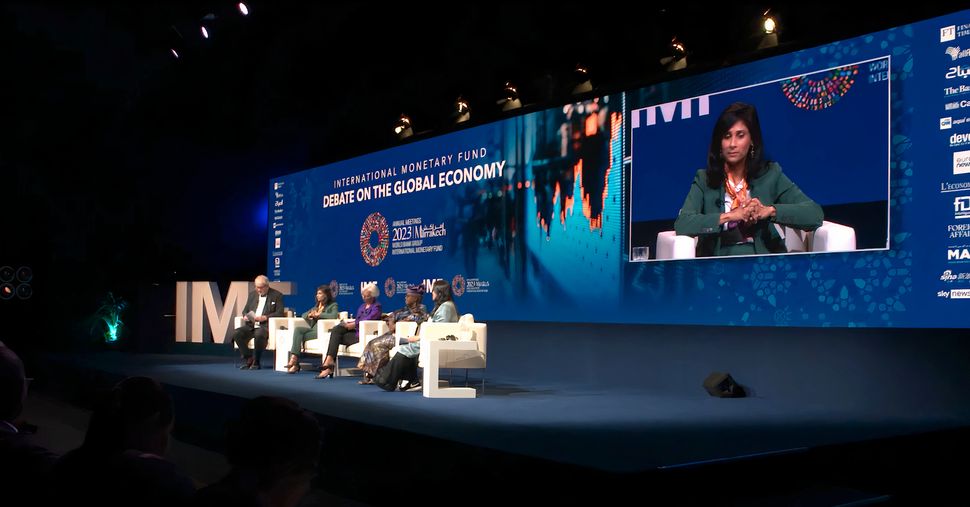
How Gravity Media ran a centralized media operation for the IMF Annual Meeting

Over 100 high-profile sessions across six days. 35 meeting rooms running simultaneously. Thousands of media assets moving between production teams, meeting-room operators, and international press on deadline. When Gravity Media needed to manage multimedia content for the IMF Annual Meeting in Marrakesh, the biggest challenge was coordination at a scale where a gap in visibility leads to a delivery failure. They deployed a purpose-built media operations environment on MediaLab.
Book a demo
Gravity Media
00SNAPSHOT

PROBLEM

An event operation that required real-time coordination of thousands of assets across dozens of rooms and stakeholder groups, with no tolerance for delay, duplication, or access errors.

COMPANY

Gravity Media, international media services and production company

FOUNDED

2000

SIZE

1,001–5,000 employees

LOCATION

Watford, United Kingdom

SCALE

35 meeting rooms served simultaneously. 6,000+ media assets across six days. Production teams, meeting-room operators, and international press all working from the same system.

KEY OUTPUT

A tailored Media Asset Management environment configured for the IMF Annual Meeting, covering ingest, internal distribution, press access, and post-event archiving.

01
Coordination across 35 rooms, under live event pressure

The IMF Annual Meeting is one of the most media-intensive gatherings on the global calendar. Over 100 high-profile sessions ran across six days.

Gravity Media was responsible for managing the full media workflow: staging presentation materials, visual content, and audio files for 35 meeting rooms, managing real-time ingest from production teams, and distributing approved content to international press contacts. And this all across 8 different venues.

The pressure was not just operational volume. Each meeting room had its own content requirements. Presentations needed to be staged in advance and available on demand. Press teams needed structured, immediate access to approved assets without navigating irrelevant content. Internal teams needed to see what had arrived and what was still outstanding, in real time.

At that scale, coordination gaps compound. A misfiled asset is a missed deadline. An access error is a security exposure. The operation demanded a media management system that could handle the structure and the speed simultaneously, the current system simply couldn't scale.

02
What the event demanded from a platform

The requirements were shaped by the event itself, not by a generic procurement checklist:

  • A folder architecture that mapped to the meeting structure
  • Granular user management: press, internal teams, and meeting-room operators each scoped to exactly what they needed
  • A custom metadata taxonomy for consistent categorization and fast retrieval under live conditions
  • Real-time distribution workflows for international press, eliminating manual handoffs
  • A post-event archiving path that preserved structure and metadata, not just files

MediaLab could be configured as a tailored MAM environment designed around the Marrakesh meeting structure. Built for the specific operational reality of this event: 35 rooms, six days, thousands of assets, multiple stakeholder groups with different access needs.

03
How the rollout worked

MediaLab worked directly with Gravity Media and the event organizers to configure the environment from the ground up: onboarded three months prior to the event, MediaLab completed the whole setup, tested the system, and provided on-call support during the event.

The folder architecture came first. An organized system built around the meeting structure ensured each team could access exactly what they needed without navigating irrelevant content. Each of the 35 meeting rooms had its own workflow context, with presentations, visual assets, and audio files staged in advance and available on demand.

User management was configured alongside it. Press, internal teams, and meeting-room operators each received scoped, appropriate access. Granular controls ensured the right credentials reached the right people without overlap.

A purpose-built metadata taxonomy made categorization consistent across the entire operation. Under live-event conditions, content could be located and moved quickly. No searching through undifferentiated folders.

Distribution workflows for international press went live with the rest of the system. Approved content was structured and accessible immediately, eliminating delays and manual handoffs across time zones.

04
What MediaLab delivered at Marrakesh

Over six days, Gravity Media's team managed and distributed 6,000+ media files in real time without operational failure. Internal meeting rooms received content on schedule. Press had structured, immediate access to approved assets. The system held under sustained load. And was of course, the starting point of many newsfeeds into peoples homes.

BEFORE / AFTER

The shift, in plain terms

BEFORE

  • A system that wasn't built for scale, prone to gaps and difficult to coordinate
AFTER

  • Centralized media operation across 35 simultaneous meeting rooms
  • 6,000+ assets managed and distributed in real time
  • Scoped access for press, internal teams, and room operators
  • Content staged in advance and available on demand per room
  • Consistent metadata across the entire event
  • Real-time visibility on what had arrived and what was outstanding
  • Operational confidence from doors-open onward
Not only did MediaLab help us out perfectly during the event, but their flexibility also enabled us to provide a well-thought-out post-event workflow. MediaLab offered us a solid archiving solution with a touch of MAM.
CHRIS DEMEULEEMEESTER, INTERNATIONAL SALES MANAGER, GRAVITY MEDIA
BUILT ON MEDIALAB

IMF Annual Meeting, Marrakesh

IMF Annual Meeting
IN PRODUCTION

A tailored Media Asset Management environment configured for live-event operations at institutional scale. Used by Gravity Media's production team, meeting-room operators, and international press across a six-day event.

Structured folder architectureMapped to the 35-room meeting layout.
Granular user managementPress, internal, and room operators scoped separately.
Custom metadata taxonomyConsistent categorization and fast retrieval.
Real-time press distribution workflowsNo manual handoffs.
Unlimited contributorsNo per-seat pricing.
Post-event archiveStructure and metadata preserved.

05·

What this foundation makes possible next

The live event is over. The archive is not.

Working with Gravity Media, the team made deliberate decisions about what to preserve and how. Only essential content was retained for long-term accessibility. The rest was released. Retained content is stored in Azure Cold Storage through MediaLab's archive feature: cost-effective, ISO 27001 compliant, and accessible to future event organizers without requiring reconstruction of the original system.

The archive is not a graveyard. It is a working reference library. The structure, metadata, and access logic from Marrakesh are preserved and transferable. Future iterations of the meeting have a foundation to build from, not a blank canvas.

At institutional event scale, that foundation is key: every new session added to a future meeting inherits the same operational structure. Every new press contact who receives access inherits the same controls.

There is no renegotiation with infrastructure every time a new event cycle begins. You've got a platform you build on, not just a tool you license.


Join the companies that trust MediaLab to keep media moving.

In 15 minutes, we'll show how MediaLab integrates with your existing tools, reduces operational risk, and simplifies media workflows without replacing what already works.